An IBM Maximo system under data pressure
SUEZ SA, a global leader in water and environmental management, relies on IBM Maximo to manage all of its field operations under the IPOP project. After years of operation, the active database tables had accumulated millions of work orders with the "Archived" status.
This gradual overload was degrading search response times, slowing down operational queries, and posing a growing risk to system stability. It had become essential to act — without sacrificing access to historical data.
The challenge: archive without interruption, without data loss
Automatically move closed work orders to dedicated archive tables, while maintaining service continuity and the integrity of historical data.
- Large volume of data spread across 6 linked tables (
WORKORDER,WOSTATUS,LABTRANS…) - Absolute service continuity — no network interruption tolerated
- Zero performance degradation of Maximo in production
- Full traceability and governance of archiving operations
Solution selection: comparison of the three approaches
Sinorfi analysed three archiving architectures available in the IBM Maximo ecosystem before recommending the optimal solution.
| Criterion | Solution 1 — Native Java | Solution 2 — Java + SQL | Solution 3 — Standalone SQL Job |
|---|---|---|---|
| Performance | Slow on large volumes | Correct but limited execution | ✓ Runs outside Maximo JVM — optimal on any volume |
| Network outage | Processing interrupted | Processing interrupted | ✓ No impact — the SQL Job continues independently |
| Maximo resources | High Java consumption | High system utilization | ✓ No allocation from Maximo |
| Application impact | Risk of crash | Possible slowdown | ✓ No direct impact on Maximo |
| Stability | Less reliable | Overload risks | ✓ Very reliable — standalone SQL processing |
Architecture: a Maximo-decoupled solution driven by SQL Job
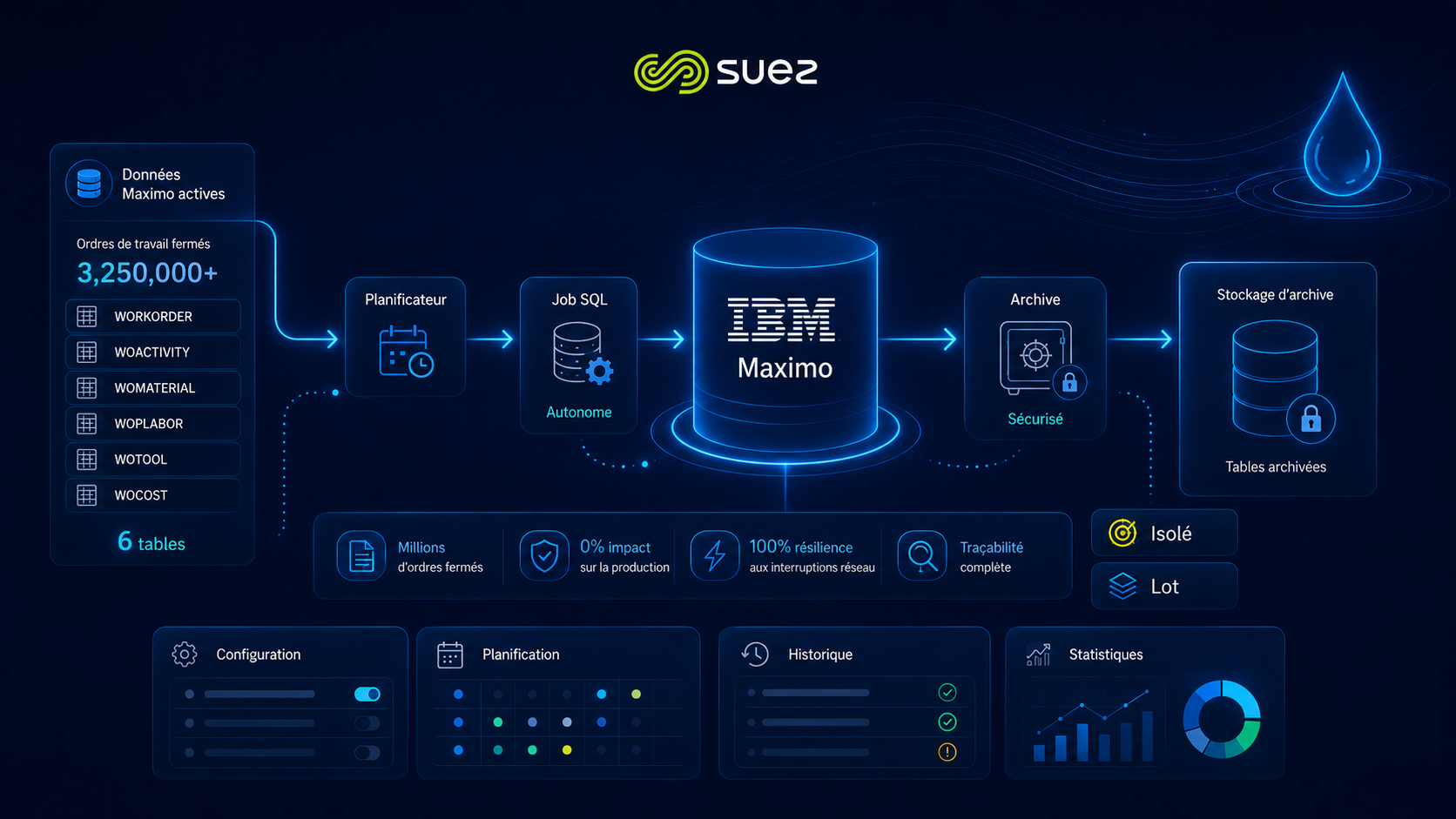
The solution is built on a dedicated SQL Server filegroup for archiving, physically separating historical data from active data. This decoupling ensures that no archiving operation consumes Maximo application resources.
A Maximo periodic task (INSTANCE) triggers the SQL Job according to the defined schedule. The Job then orchestrates the full cycle autonomously: copying to archive tables, deleting from active tables, and logging operations.
Mirror archive tables are synchronised in real time with the structure of the main tables. Any subsequently added attribute only requires a targeted update, ensuring the scalability of the solution.
Tech stack: IBM Maximo · SQL Server Job · Periodic Task · Dedicated Filegroup · Mirror Tables
Two archiving modes adapted to every need
- 01 — Isolated Mode · Single archivingProcessing of an individual work order with all its linked sub-objects (statuses, labour, addresses…). Ideal for targeted corrections and verifying a specific case before a bulk archiving run.
- 02 — Batch Mode · Bulk archivingGrouped processing of a set of work orders according to configurable criteria (status, date, group). Designed for large-scale planned purges, maximising the efficiency of maintenance operations.
A management interface integrated into IBM Maximo
Sinorfi developed and natively integrated into Maximo an application Archiving Configuration, accessible to MAXADMIN administrators, covering the entire lifecycle.
- ConfigurationConfiguration of main tables, archive tables, archiving groups, execution conditions (Isolated / Batch) and associated child tables.
- PlanificationScheduling of processing instances with choice of method, frequency and target group. View of the active schedule.
- HistoriqueFull operation tracking: execution status, date, affected table, group, method used and detailed error messages.
- StatisticsVisualisation of archived volume evolution by table and year, enabling capacity management and anticipation of future needs.
- EscaladeMechanism for escalating processing anomalies to alert technical teams in the event of a SQL Job failure.
- Liste des archivesCentralised browsing of all available archives, with filters by object, period and group to quickly locate historical data.
Results: concrete, measurable benefits
- Streamlined active database — Maximo operational tables now contain only live data. Searches and reports are significantly faster, with a direct reduction in load on the SQL Server engine.
- Full service continuity — Thanks to the standalone SQL Job architecture, archiving operations never impact Maximo users. No slowdown or application interruption has been observed in production.
- Preserved access to historical data — Dedicated archive tables maintain all historical data, accessible at any time from the Maximo interface with no reconstruction delay.
- Full governance and traceability — Every operation is logged: date, table, group, method, status. SUEZ teams have full visibility over the complete archiving history.
- Scalable and autonomous solution — The modular architecture allows archiving to be extended to new Maximo objects without redesign. Administrators manage everything from the native interface, with no dependency on Sinorfi for routine operations.